Industrial PoE Without Compromise: TP-Link IES210GPP
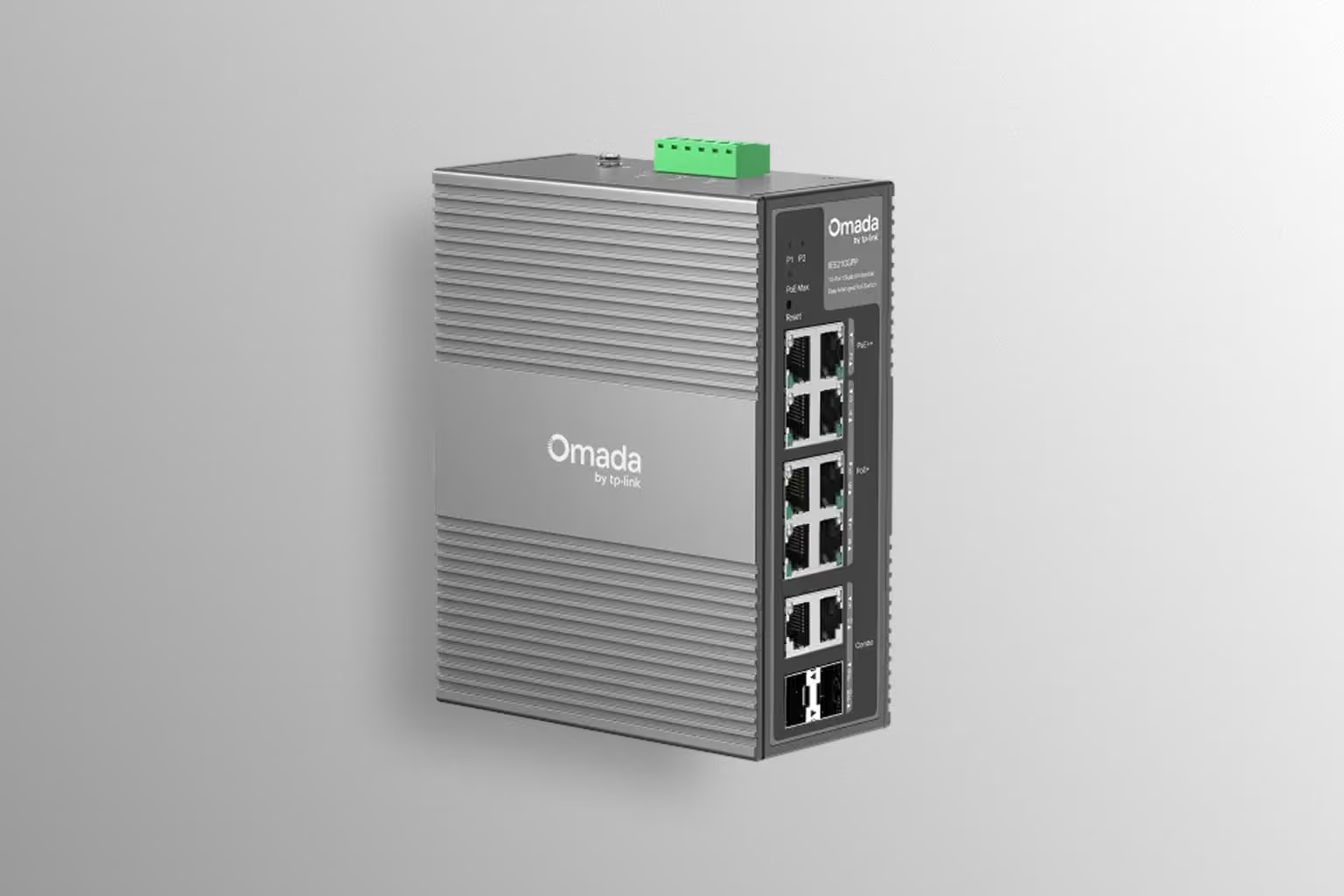
For environments where voltage fluctuates, cabinet space is tight, and uptime is non-negotiable, the IES210GPP stands out as one of TP-Link’s more mature industrial designs. It’s a compact, fully managed Gigabit switch built around a simple idea: deliver stable PoE to cameras and sensors, regardless of what the DC input is doing.
In practice, that stability comes from an integrated DC/DC converter that maintains consistent PoE output even when the power supply dips toward the lower end of its 12–57 V input range. This is not a theoretical benefit. When powering a camera at just 24 V, the switch continued to deliver a clean and sufficient PoE budget, and the monitoring dashboard gave an impressively detailed view of voltage, current, device class, and actual power consumption.
A rugged metal chassis, DIN-rail mounting, and clear LED indicators make it genuinely industrial-ready rather than “industrial-themed”. The management layer can be accessed locally through a browser or via the Omada Controller. Once the switch is adopted into Omada, all configuration becomes centralised — a logical trade-off for anyone running multiple sites or large surveillance deployments.
The only meaningful limitations are the reduced PoE budget at lower voltages and the absence of 10G uplink. For many CCTV-oriented installations this won’t matter, but in mixed industrial networks where high-bandwidth aggregation is expected, it is something to note.
A Router for Real Corporate Workloads: TP-Link ER7406
If the IES210GPP is built for physical robustness, the ER7406 is built for administrative clarity. It’s a router engineered for organisations that need reliable multi-WAN connectivity, hardened security, and full VPN coverage without relying on cloud-only management.
One of the most valuable aspects of the ER7406 is how comprehensively it can be configured through its local web interface. WAN and LAN setup, VLAN segmentation, IPS/IDS configuration, firewall rules, NAT policies, QoS, routing tables, and user management can all be handled without touching either Omada or the cloud portal. This keeps the device perfectly suitable for closed networks and regulated environments where remote dependency is undesirable.
Its VPN capabilities are unusually broad for this segment. The router supports IPsec, OpenVPN, WireGuard, SSL VPN, GRE, and even legacy options like PPTP. Setting up secure tunnels requires no CLI knowledge: the UI allows administrators to define IP pools, routes, authentication methods, and client permissions with a level of clarity that many competing routers lack.
Security features are equally comprehensive, with protection against ARP spoofing, DoS attacks, and port scans, combined with traffic categorisation and MAC/IP filtering. System monitoring gives a real-time view of CPU load, memory consumption, active sessions, and bandwidth usage — essential information for anyone managing a heavily loaded gateway.
Its weaknesses are mostly architectural: there is no integrated Wi-Fi, routing customisation is less granular than MikroTik, and centralised AP management still requires Omada. But as a dedicated router for corporate WAN and VPN duties, it performs with confidence.
Enterprise Wi-Fi 6 Done Simply: TP-Link EAP653
The EAP653 is a Wi-Fi 6 access point aimed at offices, campuses, and hospitality spaces where a mix of capacity, stability, and easy expansion matters more than extreme radio customisation. It supports both 2.4 GHz and 5 GHz bands, offers multiple SSIDs with VLAN tagging, and integrates seamlessly with Omada’s SDN architecture.
What stood out during configuration was the balance between simplicity and control. Without connecting to Omada, the access point already allows adjustments to transmit power, channel width, Beacon Interval, DTIM settings, fragmentation thresholds, and OFDMA behaviour. For networks with high client density, OFDMA makes a notable difference — simultaneous upstream and downstream allocations reduce congestion and improve overall throughput, especially in mixed environments with both modern and older devices.
When multiple EAP units are deployed, Omada’s controller becomes the natural next step. It provides easy scaling, unified policy enforcement, and centralised firmware updates. Industry reports often mention that Omada deployments remain stable past 200 devices, which aligns with the EAP653’s intended role in larger setups.
It is not the most configurable access point on the market — MikroTik still leads in granular radio controls — and there is no built-in controller for small standalone deployments. But for organisations prioritising predictable performance and clean integration, the EAP653 delivers exactly that.
Final Thoughts: A Practical, Cohesive Infrastructure for Modern Networks
What makes these three TP-Link devices interesting is not just their individual strengths, but how cleanly they operate as part of a unified environment. The IES210GPP brings power stability to industrial networks, the ER7406 delivers serious VPN and WAN performance without cloud dependence, and the EAP653 offers enterprise-grade Wi-Fi 6 that scales reliably with Omada.
For businesses building a modern infrastructure — whether it’s a surveillance-heavy industrial site or a corporate office with hundreds of users — this combination provides a surprisingly capable and cost-efficient alternative to more premium vendors. The ecosystem is mature enough for serious work, flexible enough for multi-site deployments, and straightforward enough that daily administration doesn’t turn into a full-time job.