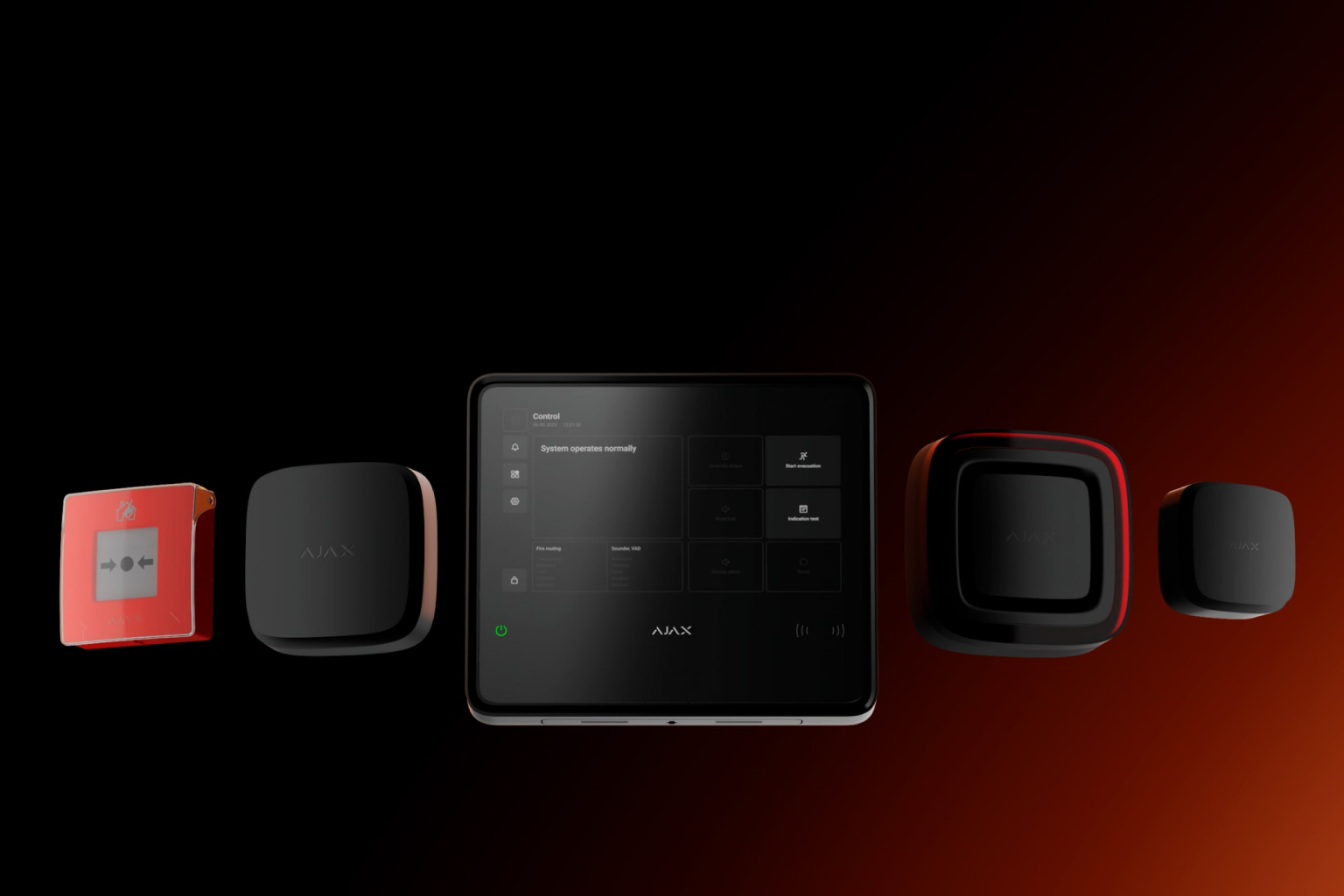
The goal behind Ajax’s fire-safety platform is straightforward: ensure a protected environment while reducing installation complexity and maintenance burden. Yet its approach and technical constraints differ from the company’s standard product line, primarily due to the strict requirements imposed by EN-54 standards. As a result, not all Ajax devices are compatible with this specific lineup. Fireba devices and the FireProtect 2 series, for example, are excluded because their architecture does not match the certification framework.
What sets the “Fire and Life Safety” platform apart is its compliance with EN-54 and its ability to function as a complete UATS (fire detection and alarm system) rather than merely a stand-alone smoke detection solution. For buildings where a wireless approach is the only practical option — older properties, finished commercial interiors, or facilities where cable routing is prohibited — this provides an appealing alternative to conventional wired infrastructure.
The EN-54 Architecture Behind the System
At the centre of the Ajax fire system is the EN54 Fire Hub Jeweller, supported by the EN54 Fire ReX Jeweller wireless range extenders. This hub can accommodate up to 200 wireless devices, manage 40 fire detection zones, and support five Fire ReX repeaters, creating enough radio coverage for multi-storey office buildings, residential blocks, and compact hospitality facilities.
The configuration capabilities extend beyond fire detection. A single hub can organise up to 80 rooms, add 36 NVRs, integrate 224 cameras, run 64 automation scenarios, register 200 users, and store 5000 events. This makes the platform a true hybrid system, particularly suited for sites that require both security-grade monitoring and certified fire protection.
Certification is comprehensive. The Fire Hub meets EN 54-2, EN 54-4, EN 54-21 and EN 54-25 requirements, confirmed by Dedal Attestation and Certification LTD under CPR regulation. Combined radio coverage reaches up to 1800 metres, providing enough reach for most residential and small commercial sites even through standard wall and ceiling materials.
For power autonomy, the Fire Hub accepts EN-54 compliant internal batteries rated for 24-hour or 72-hour operation. This satisfies European backup requirements and ensures system continuity during outages.
How the Devices Work in Practice
Ajax relies on its Jeweller radio protocol and a set of patented technologies to reduce false alarms — a critical requirement for EN-54 certification. Smoke detectors feature an engineered optical chamber and dual-sensor analysis, allowing them to examine the structure of smoke particles rather than relying on a single reading. Heat detectors use a double logic method, reacting both to sustained temperature above 50°C and to sudden rises that indicate a developing fire.
The lineup includes smoke detectors, heat detectors, combined models with built-in sirens, as well as sounders and visual alarm devices (VAD). Maximum sound output reaches 95 dB for detectors and 100 dB for dedicated sirens, ensuring audibility in residential and office settings.
The system also offers an EN-54 certified I/O Module with two inputs and two outputs, suitable for integrating external devices operating on both AC and DC voltage ranges. Every device in the ecosystem delivers up to five years of battery life — a notable achievement for EN-54 wireless systems, provided the environment maintains stable temperatures and the number of alarms remains low.
One of the system’s safety advantages is that, should the Fire Hub fail, the remaining devices can still transmit fire alarms to one another. This decentralised approach adds resilience uncommon in most consumer-grade wireless solutions.
Where the System Excels
The greatest strength of the Ajax EN-54 line is its ability to bring certified fire detection into environments where traditional wiring is impossible or prohibitively expensive. Renovated offices, heritage buildings, rented premises, and finished residential properties benefit from rapid installation with minimal intrusion. The wider Ajax ecosystem — intrusion detection, cameras, automation, access control — gives the system a versatility that wired EN-54 solutions rarely match.
Remote access through the Ajax mobile and desktop applications is another practical advantage. Users, service providers, or multiple tenants can receive events in real time, manage permissions, and maintain visibility without the complexity of traditional fire alarm interfaces. Multi-channel communication (Ethernet, Wi-Fi, GSM) ensures redundancy in event transmission, which is particularly important when the system is linked to a central monitoring station (CAP).
Limitations You Need to Know
Despite its strengths, the Ajax EN-54 fire line is not universal. It is fundamentally limited by wireless range, building materials, and the maximum number of devices and repeaters allowed under the certification constraints. Large industrial halls, thick reinforced concrete structures, and metal-clad warehouses will often exceed what a wireless EN-54 network can realistically cover.
Several device categories are not yet available in EN-54 certified wireless form, including:
– combined smoke/heat detectors
– manual call points
– outdoor sirens
– beam detectors for large open spaces
– indicators for above-ceiling installations
– devices rated IP65 or higher
– devices for extreme temperatures or high-humidity environments
This means that cold stores, saunas, heat nodes, attics, hangars, and metal-structured industrial buildings remain outside the intended application scope. In such environments, traditional wired detection is still the only reliable option.
Costs are also higher than those of mainstream Ajax devices, reflecting certification requirements and the more specialised hardware. The Fire Hub does not support Latvian language at this time — a practical detail for local deployments.
Where the Ajax EN-54 Line Fits Best
Taken as a whole, the Ajax “Fire and Life Safety” platform is an effective solution for small and medium properties up to six storeys, particularly:
– offices and co-working spaces
– smaller hotels and guesthouses
– residential buildings and apartments
– public institutions without specialised rooms
– commercial sites where wiring is impractical
As long as the building does not require high-temperature, high-humidity, or high-coverage detection, the system performs reliably and installs quickly with minimal construction work.
The manufacturer has indicated that additional wireless EN-54 devices are expected in future updates, alongside configurations supporting more than one Fire Hub per Space — a change that could expand the platform to larger properties and more demanding applications.